Moving with God Together: Plan to Succeed
Numbers 1:1-5, 46 & 2:1-2
The twelve men listed in Numbers 1:5–16 are tribal representatives:
1. Elizur son of Shedeur (Reuben), My God is my Rock
2. Shelumiel son of Zurishaddai (Simeon), My friend is God
3. Nahshon son of Amminadab (Judah), Line of David and Jesus
4. Nethanel son of Zuar (Issachar), God Gave
5. Eliab son of Helon (Zebulun), God is Father
6. Elishama son of Ammihud (Ephraim), My God has heard
7. Gamaliel son of Pedahzur (Manasseh), God is my reward
8. Abidan son of Gideoni (Benjamin), My father has judged
9. Ahiezer son of Ammishaddai (Dan), My brother is a help
10. Pagiel son of Ochran (Asher), Fortune of God
11. Eliasaph son of Deuel (Gad), God has added
12. Ahira son of Enan (Naphtali). Re (Egyptian god) is a brother
These men are described as “leaders of their ancestral tribes” and “heads of Israel’s clans.” (Num 1:4–16) Each served as a spokesman for his tribe, with the Hebrew word for “assist” meaning “to stand.”[1] These men functioned as representatives for their ancestral tribes in matters of military conscription, worship leadership, and general administration.[1]
Their responsibilities extended across multiple domains. The tribal leaders helped Moses and Aaron with the census, enabling the numbering to be done accurately and efficiently.[2] The twelve names recorded in verses 5–15 recur in Numbers 2:3–31 (tribal camp arrangements), 7:12–83 (tribal offerings for the sanctuary), and 10:14–27 (tribal divisions depart from Sinai).[1] During the departure from Sinai, these leaders commanded their respective military divisions—Nahshon over Judah, Nethanel over Issachar, Eliab over Zebulun, Elizur over Reuben, Shelumiel over Simeon, Eliasaph over Gad, Elishama over Ephraim, Gamaliel over Manasseh, Abidan over Benjamin, Ahiezer over Dan, Pagiel over Asher, and Ahira over Naphtali. (Num 10:14–27)
[1] R. Dennis Cole, Numbers, The New American Commentary (Nashville: Broadman & Holman Publishers, 2000), 3b:70.
[2] Jay Sklar, Numbers, ed. Tremper Longman III and Scot McKnight, The Story of God Bible Commentary (Grand Rapids, MI: Zondervan Academic, 2023), 4:51.
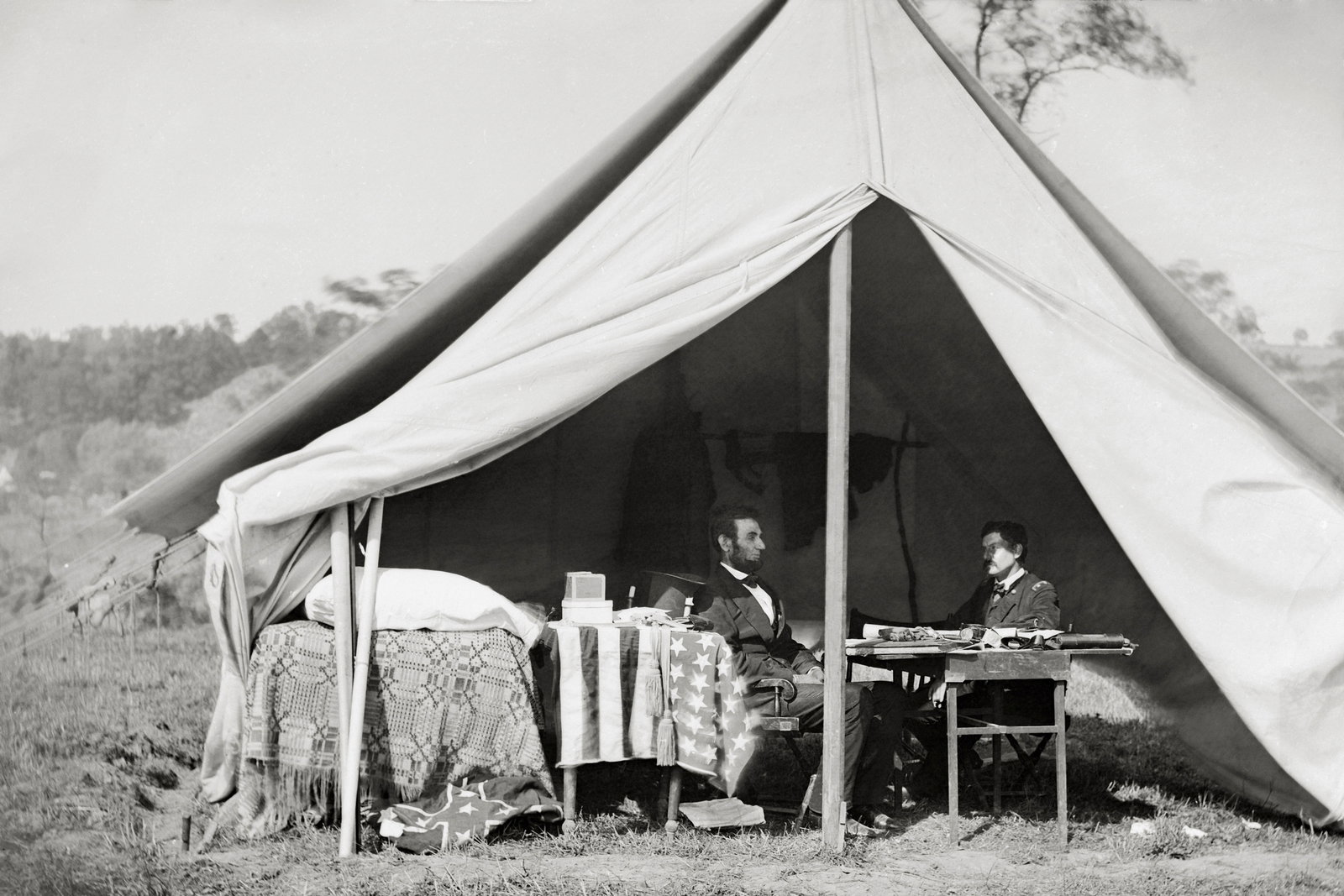
Lincoln & McClellan at Antietam, October 3, 1862
The arrangement of the 12 tribes as detailed in Numbers 2 forms the shape of a cross[1]. When the tribes and their population counts are carefully laid out as described in Numbers 2, the picture of a giant cross emerges[1].
The layout works like this: Judah, Issachar, and Zebulun positioned on the east side under the standard of the Lion[2], Ephraim, Manasseh, and Benjamin on the west side under the standard of the Ox[2], Dan, Asher, and Naphtali on the north side under the standard of the Eagle[2], and Reuben, Simeon, and Gad on the south side under the standard of the Man[2]. The tabernacle was positioned in the midst of the camp[2], creating the center point of the cross.
The top of the cross points eastward toward the Promised Land[1]. What makes this particularly striking is the theological significance: the method of putting people to death on a cross was not invented for a very long time after Numbers was written[1], yet this cross pattern appears in the very structure of Israel’s encampment. From a heavenly view, with all the tribes arranged on the north, south, east and west with the tabernacle in the midst, the camp of Israel was arranged in the shape of the cross[2].
[1] Todd Hampson, The Chronological Guide to Bible Prophecy: An Illustrated Panorama from Genesis to Revelation (Eugene, OR: Harvest House Publishers, 2022), 48–49.
[2] Kevin J. Conner, The Tabernacle of Moses (Conner Ministries, 2018), 11–12.
Jewish Contributions to Everyday Life:
Medical Breakthroughs
The Heimlich Maneuver: Henry Heimlich was an American Jewish thoracic surgeon who developed the Heimlich maneuver in 1974. This simple abdominal thrust technique has saved hundreds of thousands of people from choking to death. It is taught in every first aid class, posted in every restaurant, and known by people worldwide. Heimlich himself used his own maneuver twice in his life to save choking victims, the last time at age 96 in a retirement home in 2016. Source: American Journal of Emergency Medicine, Cincinnati Enquirer
The Polio Vaccine: Jonas Salk, as mentioned above, developed the polio vaccine in 1955, eliminating one of the most feared childhood diseases in human history.
Chemotherapy: Paul Ehrlich was a German Jewish physician and scientist who pioneered the concept of chemotherapy. His concept of using chemicals to target and kill specific disease cells became the foundation of all modern cancer chemotherapy. He won the Nobel Prize in Medicine in 1908. Source: Nobel Prize Organization
Everyday Inventions You Use:
Blue Jeans: Levi Strauss, as mentioned above, invented and patented blue jeans in 1873. Billions of people wear them every day worldwide.
The Shopping Cart: Sylvan Goldman was an Oklahoma Jewish grocery store owner who invented the shopping cart in 1937. He owned the Humpty Dumpty supermarket chain in Oklahoma City and noticed customers stopped shopping when their hand baskets got too heavy. He designed a folding cart on wheels and changed retail shopping forever. Every shopping cart in every store in the world traces back to this Oklahoma Jewish businessman. Source: Smithsonian Magazine, Oklahoma Historical Society
Google: Larry Page and Sergey Brin, both Jewish, co-founded Google in 1998 while at Stanford University. Google is now the most visited website in the world and processes over 8.5 billion searches per day. It has fundamentally changed how all of humanity accesses information. Source: Google Corporate History, abc.xyz
Facebook: Mark Zuckerberg, as mentioned above, founded Facebook in 2004, changing human communication forever.
The Ballpoint Pen: Ladislao Biro was a Hungarian Jewish journalist who invented the ballpoint pen in 1938. Frustrated with fountain pens that smeared and leaked he developed a pen using quick drying ink and a tiny rotating ball at the tip. The word Biro is still used in many countries as the common word for any ballpoint pen. You have probably used one today. Source: Encyclopedia Britannica
Instant Coffee: Nestle chemist Max Morgenthaler, who was Jewish, developed modern instant coffee in 1938 while working to find a use for Brazil's coffee surplus. His product called Nescafe became one of the most consumed beverages in human history. Millions of people start their day with instant coffee because of his work. Source: Nestle Corporate History, nestle.com
The Microphone: Emile Berliner was a German Jewish immigrant to the United States who invented the first practical microphone in 1876. He also invented the gramophone and the flat disc record which became the foundation of the entire recorded music industry. Every concert, every church sound system, every podcast, and every phone call depends on technology that traces back to Berliner. Source: Smithsonian Institution Archives
Entertainment and Media:
Superman: Jerry Siegel and Joe Shuster were two Jewish teenagers from Cleveland Ohio who created Superman in 1933. Many scholars have noted that Superman's story mirrors the Jewish experience. A baby sent away by his parents to escape destruction, arriving in a new world, hiding his true identity while fighting for justice. Superman became the foundation of the entire American comic book and superhero industry worth billions of dollars today. Source: Library of Congress, Smithsonian Magazine
Science and Technology:
The Theory of Relativity: Albert Einstein, as mentioned above, changed all of modern science and technology.
The USB Drive: Dov Moran is an Israeli Jewish engineer who invented the USB flash drive in 1999 while working at M-Systems in Israel. Before the USB drive people used floppy disks and zip drives to transfer data. The USB drive changed personal computing and data storage worldwide. You have probably used one this week. Source: IEEE Spectrum, Time Magazine
The Nobel Prize data is striking. Though representing less than half a percent of the global population, Jewish recipients hold a disproportionately high share of Nobel Prizes, particularly in physics, chemistry, and medicine. Over the past century, Jewish people—comprising just 0.02 percent of the world’s population—have received approximately one-fourth of Nobel Prizes awarded in the sciences.
The Tacoma Narrows Bridge — Washington State 1940
Tacoma Bridge Failure
- Known as Galloping Gertie, the bridge opened on July 1, 1940
- The engineer Leon Moisseiff used innovative but flawed design plans
- The plans did not adequately account for wind-induced vibration and resonance
- On November 7, 1940, the bridge began oscillating violently in 40 mph winds
- The bridge collapsed into Puget Sound just four months after opening
- The only casualty was a dog named Tubby, who could not be rescued from an abandoned car on the bridge
- It is now a standard case study in every engineering and architecture school in America